Fast Plantar Fasciitis Cure

Saturday, August 15, 2015

Metatarsalgia In Adults causes and treatment


Metatarsalgia In Adults

Metatarsalgia In Adults causes and treatment


Metatarsalgia is a general term for irritation of metatarsals. There is aching pain in the metatarsal bones of foot resulting from anatomical changes in their alignment. This is a common problem affecting the bones and joints of metatarsals. Metatarsalgia covers a group of foot disorders. Its classic symptom is pain in the front portion, or ball of foot.

Causes

The heredity factor is important. Narrow, high-arched feet can put stress on the balls of feet. Moreover, if legs are not equal in length, the metatarsal-phalangeal joints of the shorter leg receive additional stress. Skin irritation is the second factor to be considered. Metatarsalgia can occur with tender calluses under metatarsal-phalangeal joints. Foot disorders like rheumatoid arthritis, stress fractures, fluid accumulation, and muscle fatigue can also contribute towards development of metatarsalgia. If a person is born with, or develops flat feet, there is a risk for him to develop metatarsalgia. Moreover, excess weight from pregnancy or obesity can cause metatarsalgia. One should not put excessive stress on feet. For example, soldiers, letter carriers, and dancers are at a greater risk because of extensive walking and standing. Some nerve disorders like Morton’s neuroma can also cause metatarsalgia in adults.

Treatment

It is important for a person to avoid wearing tight shoes with thin soles and high heels. If one is suffering from Morton’s neuroma, he should remove his shoes periodically, and gently massage the painful area. It is also important to consult a physician for a footpad that relieves pressure on metatarsal area. A physician may prescribe non-steroidal anti-inflammatory medications such as Ibuprofen or sulindac. Such medications can treat calluses, which may be associated with metatarsalgia. In rare cases, injections of corticosteroid into the tender area may be used. An operation may sometimes be necessary. A surgeon can remove the nerve associated with painful symptoms, in severe cases of Morton’s neuroma. Other surgical options may include reshaping joints and modifying irregularly shaped bones.

A patient may inquire his doctor about the cause of pain in his feet, and whether foot disorder is involved. Moreover he can ask him whether the feet are abnormally stressed, and ways to alleviate his pain.

Friday, August 7, 2015

Metatarsalgia & Morton’s neuroma

Metatarsalgia & Morton’s neuroma

Metatarsalgia & Morton’s neuroma


Definition:

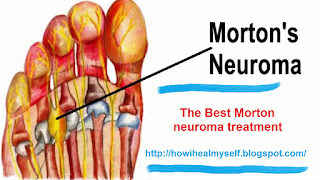
Metatarsals are the long bones located in the front part of your feet just below your toes. And Metatarsalgia — is a condition that causes burning pain and inflammation at this part of your foot.  Morton’s neuroma is a thickening of the tissue that surrounds the digital nerve leading to the toes. Morton’s neuroma occurs mostly between the third and fourth toes, because of irritation, trauma or excessive pressure in the metatarsals in the forefoot. Both these are often seen in runners and other athletes who are into high impact sports. The incidence of Morton’s neuroma is found more commonly in women than in men (ratio being 8:10).

Signs & Symptoms:

When there is an excessive amount of running and jumping and extra stress is put on the metatarsals the person suffers a sharp pain and a aching or burning sensation at the bottom of his/her foot, and this is the main symptom of metatarsalgia and Morton’s neuroma. Other symptoms of metatarsalgia and Morton’s neuroma may include pain when you stand, walk or run, numbness and unpleasantness in your toes.

Regarding Morton’s neuroma there are no outward signs, such as a lump, because this is not a tumor. In both the cases the person suffers a burning pain, which further aggravates with high intensity exercise or wearing of shoes. The pain occurs mostly in the daytime.

Diagnosis & Treatment:

The risk factor of metatarsals is higher when you are involved in high impact sports, wear ill-fitting footwear, are overweight or have other foot problems.

In such circumstances consult a doctor who would examine your foot and you may need an X-ray to identify or rule out a stress fracture or other foot problems.

During the examination for Morton’s neuroma, your doctor will feel for a palpable mass or a “click” between the bones. He or she will put pressure on the spaces between the toe bones to try to replicate the pain and look for evidence of stress fractures in the bones that might be the cause of the pain. Range of motion tests & X-rays may be required to rule out arthritis or joint inflammations.
For the treatment of Morton’s neuroma and metatarsalgia measures to be taken are to rest your foot and avoid excessive sports, apply ice packs to the affected area, take painkillers, wear proper comfortable shoes or place metatarsals pads in your footwear.

You can even get your shoes customized to help you relieve the pain and thereby reducing the pressure on the nerve. Injections would also reduce the swelling and inflammation of the nerve, bringing some relief.

Prevention is always better than cure hence avoiding wearing inappropriate shoes and maintaining a healthy weight to take the load off your feet.

TOP Morton neuroma treatment

TOP Morton neuroma treatment


The treatment of Morton neuroma depends upon the severity of the symptoms. Considering the basic symptoms to even the signs that usually occur after excessive pain. Right from choosing suitable foot wears to wearing the stilettos. The footwear one uses should be comfortable and bigger in size, which has a flat and soft sole. A change is necessary if the footwear is tight or has a high heel. This would reduce the pressure on the affected area and give relief. One can get customized shoes with pads to suit his or her comfort levels in regards to reducing the pressure on the nerve. Cortisone Injections are another way of reducing the swelling and burning sensation of the nerve.  Though too much usage of injections may lead to side effects like high blood pressure or an increase in weight hence recommended only a limited number of injections.

The Morton:

Another method of treatment can be through Physical Therapy. This process would involve a physical therapist that would help in the change of your footwear, advise soft- soles with wider and flat-soled shoes. A conservative method of reducing the pain would be to change the place of the metatarsal heads. Another recommended action is to lift the metatarsal head medial and next to the neuroma, hence preventing the chronic pain of the nerve.  The patient can also insert a felt or gel pad into the shoe to get the satisfactory lift of the metatarsal head. Thinking about the therapies that can prove to be helpful is a wise idea. 

Other possible physical therapy treatment processes for patients with Morton neuroma include cryotherapy, ultrasound, Phonophoresis, deep tissue massage, and foot stretching exercises. Even Ice can be used is beneficial to reduce the swelling and inflammation. Three may be acute symptoms that require surgery; an orthopedic surgeon should be consulted for the same. Surgical removal of the growth may be required if other fail to provide pain relief. In most cases surgery is a success but the doctor would always advice it in the end when all the other procedures would fail.

Tuesday, August 4, 2015

What can people do at home to ease their heel pain?

What can people do at home to ease their heel pain?

Heel pain, the immobilizing pain  

Since heel pain is associated with our feet that keep us moving and active and one would not be in any position to move to and fro with sore feet, one needs to take really good care and pay attention to any constant pain in the heels. Since the feet are not the most like-able part of body for everyone nor it is as active as the brain and heart it usually suffers from neglect and people pay any attention to them when they feel some nagging pain and aching in the heels. 

The human feet are subjected to various shocks and pressures and generally the feet absorb at least one thousand pounds of force in a day so one can see how difficult it is for the feet to keep moving everyday without getting tired. There are different types of heel pain and they are caused by a variety of reasons. The most common heel pain is the plantar fasciitis or heel pain where there is an inflammation of the ligament that connects the heel to the ankle muscle. There is also the Heel bursitis heel pain.  

Stretching exercises for heel pain at home :

  In the treatment of most of the heel pain there is no any surgical or invasive operation involved, simple exercises at home and rest at home are the best treatment for heel pain. Before one uses any treatment for treating heel pain one should always consult the physician this is most important in the cases of elderly people or those who are suffering from diabetes. Stretching exercises involves stretching the feet by taking the support of the wall and one can also do the towel stretching exercise at home, which involves pulling the towel placed on the ground towards oneself by curling the toes and then lifting the towel. If you are suffering from the Busitis type of heel pain one can take proper rest but this doesn’t mean that one has to stop all the daily activities but one has to restrict the use of one’s feet and not to subject it to uneven activities.   Other ways of home treatment for heel pain are the ice treatment in which one can use ice in a cloth and ice down the feet this relaxes the tired heels and stops any swelling.

Tuesday, June 30, 2015

What is heel neuroma?

 What is heel neuroma?


What is heel neuroma?

Frequently unnoticed in the discrepancy diagnosis of heel pain is neuroma of the medial calcaneal branch of the posterior tibial nerve. Heel neuroma is a significant disorder of the foot that has been misdiagnosed by physicians as heel spur syndrome. There are many studies that show how heel pain rarely has anything to do with calcaneal exostosis, but in its place could be related to heel neuroma. Heel pain is a general condition in adults that may root significant discomfort and disability. A variety of soft tissue, osseous and systemic disorders can cause heel pain. Contraction the differential diagnosis begins with a history and physical examination of the lower limit to pinpoint the anatomic source of the heel pain. The most ordinary cause of heel pain in adults is plantar fasciitis. Patients with plantar fasciitis inform about increased heel pain with their first steps in the morning or when they stand up after prolonged sitting.

What are the Sources of neuroma ? :


Softness at the calcaneal tuberosity generally is obvious on examination and is increased with passive dorsiflexion of the toes. Tendonitis also can cause heel pain. Achilles tendonitis is linked with posterior heel pain. Bursae adjacent to the Achilles tendon placing may become inflamed and cause pain. Calcaneal stress fractures are more probable to happen in athletes who participate in sports that need running and jumping. Patients with plantar heel pain accompanied by tingling, burning or numbness may have tarsal tunnel syndrome. Heel protection atrophy may present with diffuse plantar heel pain, mainly in patients who are older and obese. Less common causes of heel pain that should be considered when symptoms are prolonged or unexplained include osteomyelitis, bony abnormalities or tumor. If conservative treatment of plantar fasciitis fails to alleviate symptoms, the physician should assess for a neuroma.


TOP causes of heel pain:


There are few more causes of having heel pain. They are excessive rolling in of the feet when walking. An inflamed bursitis, a small, irritated sack of fluid at the back of the heel. A neuroma, other soft-tissue growths and heel bumps or a bone enlargement at the back of the heel bone. Bruises or stress fractures to the heel bone can be one of the major reasons to get acute heel pain known as neuroma.


Friday, June 26, 2015

What is heel spur? what is heel spur perfect treatment ?

What is heel spur?

What is heel spur?


A heel spur is a condition that affects the largest bone in human foot, the heel. A heel spur is a calcium deposit that builds when the plantar fascia pulls away from the heel area of one’s foot. The plantar fascia is a band of tissue that runs all along the bottom of a foot. Heel spurs can cause a severe type of pain when any pressure is applied to that area. A heel spur can actually be called as a hook of bone. A hook gets formed on the bone of a heel, and it in turn, causes pain by inflaming the plantar fascia.

Persons of middle age are more susceptible to heel spurs, however bone spurs can be found in any person of any age. A heel spur is usually not the primary cause of pain. It inflames and irritates the plantar fascia that causes a great discomfort in a patient. Most bone spurs can be diagnosed with an X-ray. There is a lot of stress on the tissue in the arch of one’s foot, and that tissue is anchored by the heel bone. And hence, there is a lot of stress on these tissues as well as on the heel at the same time. Footwear can also be a cause to the development of heel spurs, and it is recommended not to wear shoes having high heels.

what is heel spur perfect treatment ?

It is recommended for a patient having a heel spur to not to jog or exercise on his feet for a few days. He may also be advised to apply ice at the affected area to control pain and and inflammation. There are specific exercises and stretches that can relax the tissues surrounding one’s heel bone. Also, a medical practitioner can administer anti-inflammatory drugs for reducing pain and inflammation. Some doctors prescribe shoe inserts to allow one to continue normal activities. There are night splints that keep one’s heel stretched out at night while he sleeps. Most of the treatments or their combinations will help to alleviate the pain and inflammation of heel spurs in almost 90 days. It is said that prevention is better than cure. So, it is important to remember that spurs actually develop because of overstretching of the plantar fascia, and one needs to search for the cause of overstretching.

Wednesday, June 24, 2015

What is the most common treatment for plantar heel spur?

What is the most common treatment for plantar heel spur?


Plantar is the most common condition of heel pain. This condition occurs while the long fibrous plantar fascia ligament along the base of the foot extends tears in the tissue resulting in pain and irritation. The pain of plantar fasciitis is generally located close to where the fascia attaches to the calcaneous that is also known as the heel bone. The condition is often mispelled as plantar fascitis.
treatment for plantar heel spur
 Plantar fasciitis causes the inflammation of the plantar fascia ligament that runs along the bottom of the foot. The plantar fascia ligament is made of fibrous bands of tissue and runs among the heel bone and the toes and stretches with every step. Inflammation develops when tears occur in the tissue.

Heel spur is a pointed bony fragment that shoots from the heel bone. It extends into the reactive tissue and nerves, resulting in pain in the foot with every movement. Pain is generally more pronounced in the morning and subsides through the day but can return again later on or with action.

Symptoms of plantar heel spur:

The most common complaint from plantar fasciitis is a burning, stabbing or aching pain in the heel of the foot. The majority of sufferers will be able to feel it in the morning because the fascia ligament tightens up in the night while sleeping, causing pain to diminish. However, after coming out of bed and place pressure on the ligament it becomes taut and pain is particularly acute.

A heel spur is a common condition that results when a bone growth extends from the heel bone into the sensitive tissue in the heel. These sharp growths of bone develop when the plantar fascia is extremely and repetitively pulled away from the heel bone. In many cases a heel spur can develop along with plantar fasciitis, but can also occur by itself.

Treatment:

Avoiding plantar fasciitis is crucial. There are many options to help prevent the occurrence of this condition and keep it from recurring. One of the most important is maintaining a healthy weight in order to decrease tension on the plantar fascia. In count, shoes are very important and should fit well and provide ample cushioning and support throughout the heel, arch and ball of the foot so that weight is distributed evenly throughout the foot.

Try to avoid walking barefoot on hard surfaces and replace old shoes before they wear out. When exercising, start off slow and simple into new routines to prevent sudden or excessive stress on tissue. A heel spur can be treated with conservative treatment methods. Uneasiness can be reduced through anti-inflammatory medications, as well as cortisone injections.

 Tags: Avoiding plantar fasciitis,heel bone ,heel bone spur,plantar heel spur,
fibrous plantar fascia